Diamonds are usually thought of as products of the deep Earth, crystallising under enormous static pressure far below our feet. But some diamonds form somewhere far stranger: in space! Until now, however, extraterrestrial diamonds were assumed to be rather small.
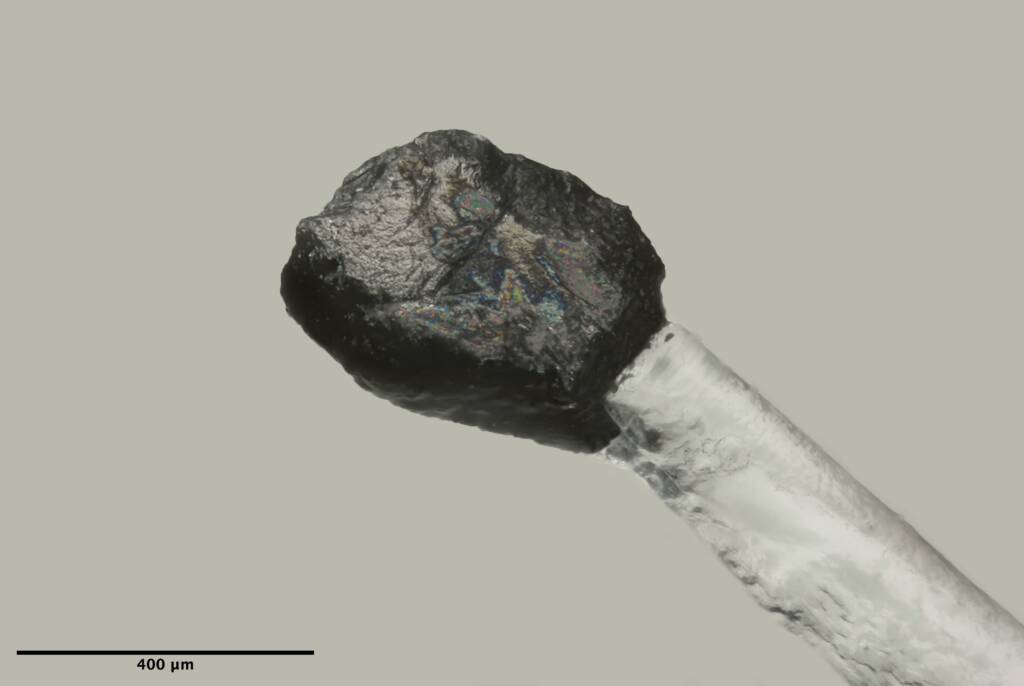
In this study, Oliver Christ and co-authors report the largest extraterrestrial diamond found to date. The sample was recovered from the highly shocked ureilite NWA 6871. After extracting it from the host meteorite, a chemical cleaning method usually reserved for gem-quality diamonds was applied to remove any accompanying graphite. That mattered enormously for the next step: measuring the diamond’s carbon isotopic composition using large-geometry secondary ion mass spectrometry on the diamond alone rather than on a mixed diamond-graphite aggregate. The isotopic results came out at δ13C = −2.89 ± 0.06 ‰ (n = 4), an intermediate value that sits comfortably within the known range for ureilitic diamonds. Plotted against the host ureilite’s Mg#, this value turns out to be pristine, meaning the carbon has remained isotopically unaltered for more than 4.5 Ga. On their own, these numbers can’t distinguish between formation models. But paired with single-crystal X-ray diffraction, a clearer picture emerges: the grain isn’t a perfect diamond, but contains portions of diaphite and stacking disorder. These are clear shock indicators, not features expected from slow, static growth.
Although extremely rare, this study demonstrates that large extraterrestrial diamonds do exist, and the result reframes how such large carbon grains in ureilites should be read: size alone doesn’t imply a quiet, deep origin. This grain was most likely formed in the very event that destroyed its parent body in the early solar system.
The photo of the diamond shown here (©2026 · ChinellatoPhoto) even made it onto the cover of the 40th volume Geochemical Perspectives Letters!