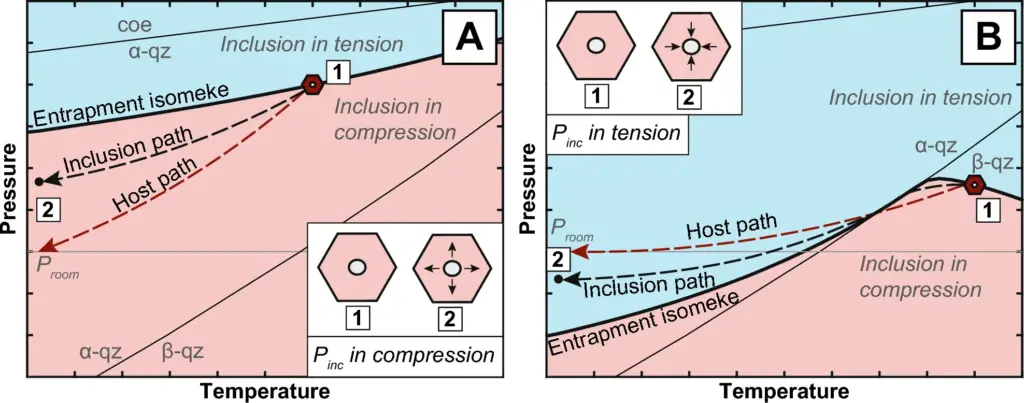
Elastic thermobarometry using quartz inclusions in garnet (QuiG) faces reliability issues in high-temperature terranes due to tensile strain. To investigate this problem, the authors analysed QuiG results from Adirondack metapelites alongside controlled piston-cylinder experiments, discovering that remnant pressures calculated using the quartz phonon-mode Grüneisen tensor were excessively tensile relative to expected values. The authors demonstrate that this discrepancy does not arise from non-elastic deformation or inaccuracies in the quartz equation of state; rather, density functional theory indicates that the structural response of quartz becomes non-linear under increasing tensile strain. Because the Grüneisen tensor relies on a linear fit optimized for compressive strains, it significantly overestimates the magnitude of tensile strains. Alternatively, calculating pressures using hydrostatic calibrations for the 128 and 464 cm⁻¹ Raman peaks yields much more accurate results that successfully return entrapment conditions aligning with known experimental and petrologic constraints. However, despite these improved results, the authors caution against relying solely on hydrostatic calibrations for inclusions under tension, as the specific behavior of Raman phonon modes under tensile stress remains experimentally uncalibrated. Read the full article “Elastic thermobarometry of natural and experimental quartz inclusions in garnet (QuiG) under tension” here!