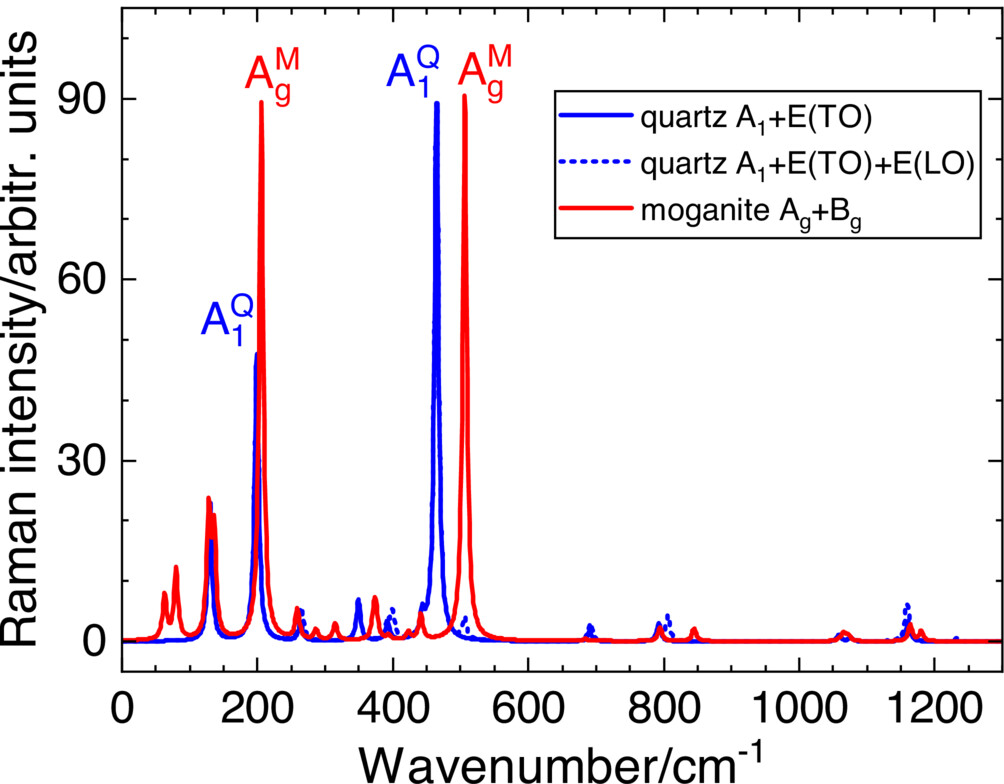
This study “Atomic Dynamics and Structural Transformations in Chalcedony as a Model Cryptocrystalline Multiphase System at Non-Ambient Conditions” uses in situ Raman spectroscopy and HF-DFT simulations to investigate chalcedony—a multiphase system of submicron quartz and moganite—under non-ambient conditions. The results confirm that the distinct Raman peak near 503 cm⁻¹ arises strictly from moganite $\text{SiO}_4$-ring vibrations rather than silanol group librations. At high pressures, the quartz component becomes metastable relative to coesite at 2.4 GPa and develops structural defects due to anisotropic strain from interacting with moganite, triggering quartz amorphization much earlier than in single crystals. Under high temperatures, Raman peaks effectively track the $\alpha\text{–}\beta$ phase transitions of both minerals, revealing that crossing the transition temperature causes part of the metastable moganite to irreversibly transform into quartz. Furthermore, the moganite phase transition alters the rate of phonon softening in quartz, demonstrating that the two phases interact dynamically through atomic vibration coupling of shared symmetry in multiphase mineral systems.