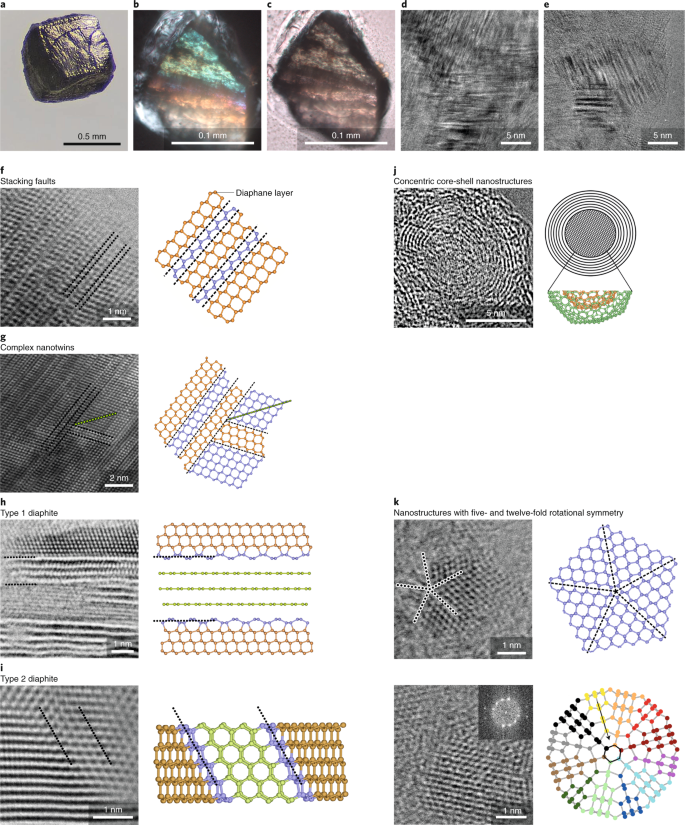
Elemental carbon exhibits remarkable structural and property versatility due to its diverse bonding capabilities. While graphite—the most stable phase at ambient conditions—is an $sp^2$-bonded, layered semimetal ideal for lubricants and battery anodes, diamond is a superhard, transparent, wide-bandgap insulator with exceptional thermal conductivity owing to its $sp^3$-bonded tetrahedral network. Beyond its historic value as a gemstone, diamond’s extreme resistance to stress makes it crucial for industrial cutting, synthetic production, protective coatings, and optoelectronics. Driven by the search for new materials with properties rivalling diamond, the list of carbon allotropes continues to expand through synthetic methods, theoretical predictions, and extraterrestrial or impact-generated natural discoveries—now encompassing fullerenes, nanotubes, graphene, and newly identified crystalline structures. How complex is diamond really? Learn more here!